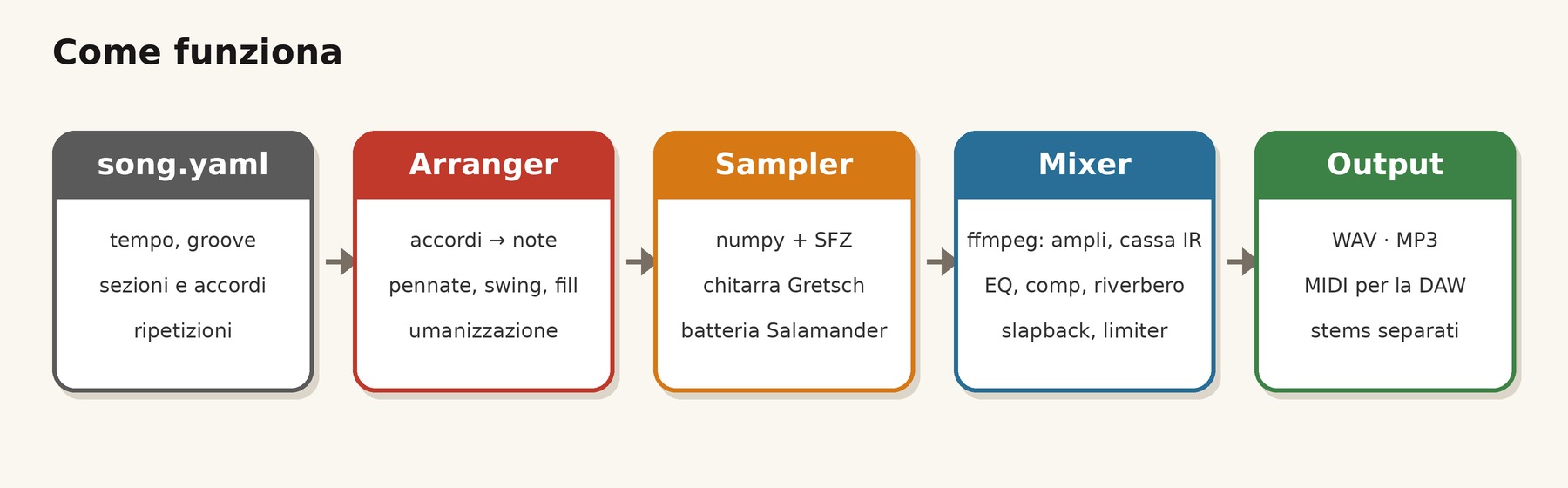
song.yaml — describe tempo, groove and sections with their chords, bar by bar.
Arranger — turns each chord into a voicing on the 6 strings and applies the groove pattern:
strums (with the real delay between one string and the next), swing, accents, fills, variations, humanization.
The result is a list of notes, as in a MIDI file.
Sampler — for each note it picks the right sample (key, dynamics, round robin), tunes it
and places it at the exact point of the track. A small engine written in numpy does it, reading
the SFZ format, the open standard for sampled instruments.
Mixer — ffmpeg runs the "direct" (DI) guitar through an amp + cabinet chain, compresses and equalizes
the drums, adds slapback and reverb, balances the levels and brings everything to a steady listening loudness.
Output — WAV/MP3 to listen to, MIDI to open in a DAW, stems to mix as you like.